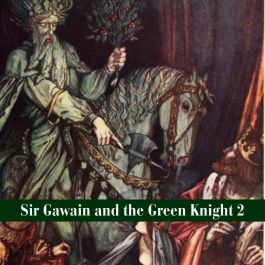
This second part of the the story starts with a lengthy piece that sets the tone.
This beginning of adventures had Arthur at the New Year; for he yearned to hear gallant tales, though his words were few when he sat at the feast. But now had they stern work on hand. Gawain was glad to begin the jest in the hall, but ye need have no marvel if the end be heavy. For though a man be merry in mind when he has well drunk, yet a year runs full swiftly, and the beginning but rarely matches the end.
For Yule was now over-past, and the year after, each season in its turn following the other. For after Christmas comes crabbed Lent, that will have fish for flesh and simpler cheer. But then the weather of the world chides with winter; the cold withdraws itself, the clouds uplift, and the rain falls in warm showers on the fair plains. Then the flowers come forth, meadows and grove are clad in green, the birds make ready to build, and sing sweetly for solace of the soft summer that follows thereafter. The blossoms bud and blow in the hedgerows rich and rank, and noble notes enough are heard in the fair woods.
After the season of summer, with the soft winds, when zephyr breathes lightly on seeds and herbs, joyous indeed is the growth that waxes thereout when the dew drips from the leaves beneath the blissful glance of the bright sun. But then comes harvest and hardens the grain, warning it to wax ripe ere the winter. The drought drives the dust on high, flying over the face of the land; the angry wind of the welkin wrestles with the sun; the leaves fall from the trees and light upon the ground, and all brown are the groves that but now were green, and ripe is the fruit that once was flower. So the year passes into many yesterdays, and winter comes again, as it needs no sage to tell us.
When the Michaelmas moon was come in with warnings of winter, Sir Gawain bethought him full oft of his perilous journey. Yet till All Hallows Day he lingered with Arthur, and on that day they made a great feast for the hero’s sake, with much revel and richness of the Round Table. Courteous knights and comely ladies, all were in sorrow for the love of that knight, and though they spake no word of it, many were joyless for his sake.
Michelmas is in late September. You’ll note that Gawan needs to find the Green Chapel by Christmas or forfeit his honour. He doesn’t even bother to start looking until November. This is, as noted in an earlier episode, England is tiny to US and Australian readers. In some later versions of this story his leave-taking is placed earlier so that the author can put detailed adventures into the quest.
And after meat, sadly Sir Gawain turned to his uncle, and spake of his journey, and said, “Liege lord of my life, leave from you I crave. Ye know well how the matter stands without more words, to-morrow am I bound to set forth in search of the Green Knight.”
He needs permission to leave: it’s a cultural value that persists to the game period.
Then came together all the noblest knights, Ywain and Erec, and many another. Sir Dodinel le Sauvage, the Duke of Clarence, Launcelot and Lionel, and Lucan the Good, Sir Bors and Sir Bedivere, valiant knights both, and many another hero, with Sir Mador de la Porte, and they all drew near, heavy at heart, to take counsel with Sir Gawain.
A lot of these characters are later to the corpus of Arthurian stories than Gawain. Mentioning them here is meant to make this author’s young Gawain heroic, much as young characters in Marvel get a scene or two with the Avengers or X-Men. It’s a bit odd, because Gawain is the hero of a lot of English stories. It’s a bit Brand New Day, for Spider-man fans.
Much sorrow and weeping was there in the hall to think that so worthy a knight as Gawain should wend his way to seek a deadly blow, and should no more wield his sword in fight. But the knight made ever good cheer, and said, “Nay, wherefore should I shrink? What may a man do but prove his fate?”
Allow me to etymology nerd for a second. Go is an irregular verb in English. A regular verb, say “jump” works like this: I jump, I jumped, I have jumped. Go is weird: I go, I went, I have gone. That “went” has replaced an older form “goed” and actually it’s a chunk of the verb “wend”. At the time it was used it meant to travel, now it means to go a specified destination by an indirect route. This is perhaps due to its similarity to the only distantly related word “wind” which means to turn around an axis. “Went”, the past tense of “wend” replaced it sometime after 1200 so it’s a new word in the game period. It might be because English drops out a heap of formal context and becomes a more practical language when the Normans arrive and say “We’ll speak it, but we won’t do
He dwelt there all that day, and on the morn he arose and asked betimes for his armour; and they brought it unto him on this wise: first, a rich carpet was stretched on the floor (and brightly did the gold gear glitter upon it), then the knight stepped on to it, and handled the steel; clad he was in a doublet of silk, with a close hood, lined fairly throughout. Then they set the steel shoes upon his feet, and wrapped his legs with greaves, with polished knee-caps, fastened with knots of gold. Then they cased his thighs in cuisses closed with thongs, and brought him the byrny of bright steel rings sewn upon a fair stuff. Well burnished braces they set on each arm with good elbow-pieces, and gloves of mail, and all the goodly gear that should shield him in his need. And they cast over all a rich surcoat, and set the golden spurs on his heels, and girt him with a trusty sword fastened with a silken bawdrick. When he was thus clad his harness was costly, for the least loop or latchet gleamed with gold. So armed as he was he hearkened Mass and made his offering at the high altar. Then he came to the king, and the knights of his court, and courteously took leave of lords and ladies, and they kissed him, and commended him to Christ.
To a modern reader this seems to take a lot of time for assumed action. This scene is the preparation for his quest. It suits a gentrified audience because they know this system and it calls out how they, as crusaders for example, are meant to start that process, with armed vigil. More generally, though, it is meant to be similar to the sanctification that occurs before religious trials. You’ll note he has multiple assistants in this process of dressing ,and that’s not how he would behave as a knight errant, because he doesn’t even take a squire. His community is preparing him.
With that was Gringalet ready, girt with a saddle that gleamed gaily with many golden fringes, enriched and decked anew for the venture. The bridle was all barred about with bright gold buttons, and all the covertures and trappings of the steed, the crupper and the rich skirts, accorded with the saddle; spread fair with the rich red gold that glittered and gleamed in the rays of the sun.
Then the knight called for his helmet, which was well lined throughout, and set it high on his head, and hasped it behind. He wore a light kerchief over the vintail, that was broidered and studded with fair gems on a broad silken ribbon, with birds of gay colour, and many a turtle and true-lover’s knot interlaced thickly, even as many a maiden had wrought diligently for seven winter long.
A vintail, or more commonly ventail, is a flap of mail that covers the lower face. He wears a handkerchief over this so that it doesn’t heat up.
But the circlet which crowned his helmet was yet more precious, being adorned with a device in diamonds.
Part of this opulence is protective. If you find a knight wearing a circlet of diamond, and you kill him, there are bound to be brutally-efficient men in far less decorative garb sent to make you suffer. In those parts of Britain that accept a blood-price for death, which does include Gawain’s family in some stories, a man coated in gold and treasure has the sort of price that only a king could pay. That he is covered in gems advertises that his ransom is likely huge and that he will honour the ransom system. Keeping a defeated Gawain alive is lucrative enough for robber knights to not kill him, if they realize who he is and decide that a vengeful high king is not worth the hassle.
Then they brought him his shield, which was of bright red, with the pentangle painted thereon in gleaming gold.
This is not the traditional coat of arms for Gawain’s family. The author has worked to put this symbol into the work, so that the following digression makes sense.
And why that noble prince bare the pentangle I am minded to tell you, though my tale tarry thereby. It is a sign that Solomon set ere-while, as betokening truth; for it is a figure with five points and each line overlaps the other, and nowhere hath it beginning or end, so that in English it is called “the endless knot.” And therefore was it well suiting to this knight and to his arms, since Gawain was faithful in five and five-fold, for pure was he as gold, void of all villainy and endowed with all virtues. Therefore he bare the pentangle on shield and surcoat as truest of heroes and gentlest of knights.
For first he was faultless in his five senses; and his five fingers never failed him; and all his trust upon earth was in the five wounds that Christ bare on the cross, as the Creed tells. And wherever this knight found himself in stress of battle he deemed well that he drew his strength from the five joys which the Queen of Heaven had of her Child. And for this cause did he bear an image of Our Lady on the one half of his shield, that whenever he looked upon it he might not lack for aid.
To pop in here, the half of the shield he is talking about is likely the inner half: he has an image of the Madonna on the inner part of his shield to make it easier for him to venerate her and request intercession. This is also a time marker for the story: Mary has a far smaller role in folk Catholicism before the 13th Century.
And the fifth five that the hero used were frankness and fellowship above all, purity and courtesy that never failed him, and compassion that surpasses all; and in these five virtues was that hero wrapped and clothed. And all these, five-fold, were linked one in the other, so that they had no end, and were fixed on five points that never failed, neither at any side were they joined or sundered, nor could ye find beginning or end. And therefore on his shield was the knot shapen, red-gold upon red, which is the pure pentangle. Now was Sir Gawain ready, and he took his lance in hand, and bade them all Farewell , he deemed it had been for ever.
Then he smote the steed with his spurs, and sprang on his way, so that sparks flew from the stones after him.
I have not ridden a great deal, but this sort of jolt where you injure your horse so that it strikes sparks on the cobbles with its iron shoes, to me, looks like a teenager doing burnouts in a sports car, if the car was able to feel pain. It’s meant to look cool, but if you’re a Bjornaer magus, it must look very needy.
All that saw him were grieved at heart, and said one to the other, “By Christ, ’tis great pity that one of such noble life should be lost! I’faith, ’twere not easy to find his equal upon earth. The king had done better to have wrought more warily. Yonder knight should have been made a duke; a gallant leader of men is he, and such a fate had beseemed him better than to be hewn in pieces at the will of an elfish man, for mere pride. Who ever knew a king to take such counsel as to risk his knights on a Christmas jest?” Many were the tears that flowed from their eyes when that goodly knight rode from the hall. He made no delaying, but went his way swiftly, and rode many a wild road, as I heard say in the book.
I’m not sure which book the author means here. It might be a reference to Issiah in the Bible. This is the part where later authors pop new adventures in.
So rode Sir Gawain through the realm of Logres, on an errand that he held for no jest. Often he lay companionless at night, and must lack the fare that he liked. No comrade had he save his steed, and none save God with whom to take counsel. At length he drew nigh to North Wales, and left the isles of Anglesey on his left hand, crossing over the fords by the foreland over at Holyhead, till he came into the wilderness of Wirral, where but few dwell who love God and man of true heart. And ever he asked, as he fared, of all whom he met, if they had heard any tidings of a Green Knight in the country thereabout, or of a Green Chapel? And all answered him, Nay, never in their lives had they seen any man of such a hue. And the knight wended his way by many a strange road and many a rugged path, and the fashion of his countenance changed full often ere he saw the Green Chapel.
Logres is the part of England Arthur controls as king, rather than via alliance or conquest. It’s loosely the southern and eastern bits of England. When Gawain is in Wales he’s out of Arthur’s land. In northern Wales he’s in the lands of one of Arthur’s great foes in the early wars of unification. The Wirral is in modern Cheshire.
Many a cliff did he climb in that unknown land, where afar from his friends he rode as a stranger. Never did he come to a stream or a ford but he found a foe before him, and that one so marvellous, so foul and fell, that it behoved him to fight. So many wonders did that knight behold, that it were too long to tell the tenth part of them. Sometimes he fought with dragons and wolves; sometimes with wild men that dwelt in the rocks; another while with bulls, and bears, and wild boars, or with giants of the high moorland that drew near to him. Had he not been a doughty knight, enduring, and of well-proved valour, and a servant of God, doubtless he had been slain, for he was oft in danger of death.
Note that what the author is focused on is, by his definition, more important and interesting than fighting dragons. Also, fighting bulls was apparently a big deal in period.
Yet he cared not so much for the strife, what he deemed worse was when the cold clear water was shed from the clouds, and froze ere it fell on the fallow ground. More nights than enough he slept in his harness on the bare rocks, near slain with the sleet, while the stream leapt bubbling from the crest of the hills, and hung in hard icicles over his head.
Cold rain is worse than dragons to Gawain, which seems odd. I may be able to rescue this, but it needs some work. In some stories, like the Morte d’Arthur, Gawain is solar powered in the sense that he is stronger in the middle of the day. He is strong for a human at 9 am, and his strength gradually increases until it peaks at noon, such that it is tripled. It then fades over the following three hours. As a solar hero, cold rain may be a flaw that diminishes his characteristics uncomfortably.
Thus in peril and pain, and many a hardship, the knight rode alone till Christmas Eve, and in that tide he made his prayer to the Blessed Virgin that she would guide his steps and lead him to some dwelling. On that morning he rode by a hill, and came into a thick forest, wild and drear; on each side were high hills, and thick woods below them of great hoar oaks, a hundred together, of hazel and hawthorn with their trailing boughs intertwined, and rough ragged moss spreading everywhere. On the bare twigs the birds chirped piteously, for pain of the cold. The knight upon Gringalet rode lonely beneath them, through marsh and mire, much troubled at heart lest he should fail to see the service of the Lord, who on that self-same night was born of a maiden for the cure of our grief; and therefore he said, sighing, “I beseech Thee, Lord, and Mary Thy gentle Mother, for some shelter where I may hear Mass, and Thy mattins at morn. This I ask meekly, and thereto I pray my Paternoster, Ave, and Credo.” Thus he rode praying, and lamenting his misdeeds, and he crossed himself, and said, “May the Cross of Christ speed me.”
We don’t know how long it has been since Gawain has taken Mass and performed reconciliation with God. This is important to him because he thinks he’s likely to die in the near future. Note that he doesn’t actually perform his prayers, he just says he devotes them to an outcome in this piece of text. He’s discussing elements of prayer that eventually evolve into the modern Rosary.
Making the Sign of the Cross begins and ends the praying of the Rosary which I think is being referenced here.
The “Ave” here is the prayer that in English is called “Hail Mary” after its first two words. It doesn’t appear in text until 1050, and the modern, intercessional ending (where Mary is asked to pray for sinners) dates from the 1450s. A character in 1220 likely doesn’t add the intercession, and this makes the Ave just four lines long. As part of the Rosary it is prayed in sets of ten, called decades, usually for five sets.
The Paternoster “Our Father” is often called the Lord’s Prayer in English. It’s said one per decade when praying the rosary and once in the preparatory prayers. Textually it doesn’t vary a lot because its a Biblical quotation from the Sermon on the Mount, but the final little hymn (the doxology) doesn’t appear in the early texts. The Book of Common Prayer translates this extra bit, which was an interpolation in to the book they translated, as
“For thine is the kingdom,
the power, and the glory,
For ever and ever.
Amen.”
Gawain, as a Catholic who prays in Latin, would likely use the simpler Catholic form that doesn’t include the doxology. It enters Catholic liturgy in 1969 and doesn’t sit at the end of the Pater Noster, there’s a brief prayer between the two called the embolism. All of which is to say: Gawain likely doesn’t say it.
The Creed I assume to be the Apsotle’s Creed because it is used in the prayer to prepare for the decades of the Rosary. I’m making a definition here between the Apostle’s Creed and the Nicene Creed which is used in the Mass. The Nicene Creed says similar things but is longer and more detailed. Unlike the other texts this one gains additional clarification over time, by way of most extreme example, the Anglican Church has two official versions.
Now that knight had crossed himself but thrice ere he was aware in the wood of a dwelling within a moat, above a lawn, on a mound surrounded by many mighty trees that stood round the moat. ‘Twas the fairest castle that ever a knight owned; built in a meadow with a park all about it, and a spiked palisade, closely driven, that enclosed the trees for more than two miles. The knight was ware of the hold from the side, as it shone through the oaks. Then he lifted off his helmet, and thanked Christ and S. Julian that they had courteously granted his prayer, and hearkened to his cry. “Now,” quoth the knight, “I beseech ye, grant me fair hostel.” Then he pricked Gringalet with his golden spurs, and rode gaily towards the great gate, and came swiftly to the bridge end.
I’m guessing that’s St Julian the Hospitalier, patron of travelers, knights, hunters and, for reasons I’m not clear on, clowns.
The bridge was drawn up and the gates close shut; the walls were strong and thick, so that they might fear no tempest. The knight on his charger abode on the bank of the deep double ditch that surrounded the castle. The walls were set deep in the water, and rose aloft to a wondrous height; they were of hard hewn stone up to the corbels, which were adorned beneath the battlements with fair carvings, and turrets set in between with many a loophole; a better barbican Sir Gawain had never looked upon. And within he beheld the high hall, with its tower and many windows with carven cornices, and chalk-white chimneys on the turreted roofs that shone fair in the sun. And everywhere, thickly scattered on the castle battlements, were pinnacles, so many that it seemed as if it were all wrought out of paper, so white was it.
The knight on his steed deemed it fair enough, if he might come to be sheltered within it to lodge there while that the Holy-day lasted. He called aloud, and soon there came a porter of kindly countenance, who stood on the wall and greeted this knight and asked his errand.
“Good sir,” quoth Gawain, “wilt thou go mine errand to the high lord of the castle, and crave for me lodging?”
“Yea, by S. Peter,” quoth the porter. “In sooth I trow that ye be welcome to dwell here so long as it may like ye.”
Then he went, and came again swiftly, and many folk with him to receive the knight. They let down the great drawbridge, and came forth and knelt on their knees on the cold earth to give him worthy welcome. They held wide open the great gates, and courteously he bid them rise, and rode over the bridge. Then men came to him and held his stirrup while he dismounted, and took and stabled his steed. There came down knights and squires to bring the guest with joy to the hall. When he raised his helmet there were many to take it from his hand, fain to serve him, and they took from him sword and shield.
Sir Gawain gave good greeting to the noble and the mighty men who came to do him honour. Clad in his shining armour they led him to the hall, where a great fire burnt brightly on the floor; and the lord of the household came forth from his chamber to meet the hero fitly. He spake to the knight, and said: “Ye are welcome to do here as it likes ye. All that is here is your own to have at your will and disposal.”
“Gramercy!” quote Gawain, “may Christ requite ye.”
As friends that were fain each embraced the other; and Gawain looked on the knight who greeted him so kindly, and thought ’twas a bold warrior that owned that burg.
Of mighty stature he was, and of high age; broad and flowing was his beard, and of a bright hue. He was stalwart of limb, and strong in his stride, his face fiery red, and his speech free: in sooth he seemed one well fitted to be a leader of valiant men.
Then the lord led Sir Gawain to a chamber, and commanded folk to wait upon him, and at his bidding there came men enough who brought the guest to a fair bower. The bedding was noble, with curtains of pure silk wrought with gold, and wondrous coverings of fair cloth all embroidered. The curtains ran on ropes with rings of red gold, and the walls were hung with carpets of Orient, and the same spread on the floor. There with mirthful speeches they took from the guest his byrny and all his shining armour, and brought him rich robes of the choicest in its stead. They were long and flowing, and became him well, and when he was clad in them all who looked on the hero thought that surely God had never made a fairer knight: he seemed as if he might be a prince without peer in the field where men strive in battle.
Then before the hearth-place, whereon the fire burned, they made ready a chair for Gawain, hung about with cloth and fair cushions; and there they cast around him a mantle of brown samite, richly embroidered and furred within with costly skins of ermine, with a hood of the same, and he seated himself in that rich seat, and warmed himself at the fire, and was cheered at heart. And while he sat thus the serving men set up a table on trestles, and covered it with a fair white cloth, and set thereon salt-cellar, and napkin, and silver spoons; and the knight washed at his will, and set him down to meat.
Samite is a heavy, woven silk from northern Italy. Note that he washes after dressing not after taking off his travel clothes.
The folk served him courteously with many dishes seasoned of the best, a double portion. All kinds of fish were there, some baked in bread, some broiled on the embers, some sodden, some stewed and savoured with spices, with all sorts of cunning devices to his taste. And often he called it a feast, when they spake gaily to him all together, and said, “Now take ye this penance, and it shall be for your amendment.” Much mirth thereof did Sir Gawain make.
The joke about the penance here is that he’s eating only fish, and so he’s fasting technically, but the food is so opulent that it counts only in the most distant of senses.
Then they questioned that prince courteously of whence he came; and he told them that he was of the court of Arthur, who is the rich royal King of the Round Table, and that it was Gawain himself who was within their walls, and would keep Christmas with them, as the chance had fallen out. And when the lord of the castle heard those tidings he laughed aloud for gladness, and all men in that keep were joyful that they should be in the company of him to whom belonged all fame, and valour, and courtesy, and whose honour was praised above that of all men on earth.
He’s a young knight of few accomplishments by his own account earlier, but not here. Isd this modesty on his part, or courtesy on his host’s?
Each said softly to his fellow, “Now shall we see courteous bearing, and the manner of speech befitting courts. What charm lieth in gentle speech shall we learn without asking, since here we have welcomed the fine father of courtesy. God has surely shewn us His grace since He sends us such a guest as Gawain! When men shall sit and sing, blithe for Christ’s birth, this knight shall bring us to the knowledge of fair manners, and it may be that hearing him we may learn the cunning speech of love.”
By the time the knight had risen from dinner it was near nightfall. Then chaplains took their way to the chapel, and rang loudly, even as they should, for the solemn evensong of the high feast. Thither went the lord, and the lady also, and entered with her maidens into a comely closet, and thither also went Gawain. Then the lord took him by the sleeve and led him to a seat, and called him by his name, and told him he was of all men in the world the most welcome. And Sir Gawain thanked him truly, and each kissed the other, and they sat gravely together throughout the service.
Then was the lady fain to look upon that knight; and she came forth from her closet with many fair maidens. The fairest of ladies was she in face, and figure, and colouring, fairer even than Guinevere, so the knight thought. She came through the chancel to greet the hero, another lady held her by the left hand, older than she, and seemingly of high estate, with many nobles about her. But unlike to look upon were those ladies, for if the younger were fair, the elder was yellow. Rich red were the cheeks of the one, rough and wrinkled those of the other; the kerchiefs of the one were broidered with many glistening pearls, her throat and neck bare, and whiter than the snow that lies on the hills; the neck of the other was swathed in a gorget, with a white wimple over her black chin. Her forehead was wrapped in silk with many folds, worked with knots, so that naught of her was seen save her black brows, her eyes, her nose and her lips, and those were bleared, and ill to look upon. A worshipful lady in sooth one might call her! In figure was she short and broad, and thickly made–far fairer to behold was she whom she led by the hand.
As a spoiler, the ugly lady is Morgana Le Fay. Is she hideous as a way to hide herself? She’s Gawain’s aunt, although the two of them low-key hate each other.
When Gawain beheld that fair lady, who looked at him graciously, with leave of the lord he went towards them, and, bowing low, he greeted the elder, but the younger and fairer he took lightly in his arms, and kissed her courteously, and greeted her in knightly wise. Then she hailed him as friend, and he quickly prayed to be counted as her servant, if she so willed. Then they took him between them, and talking, led him to the chamber, to the hearth, and bade them bring spices, and they brought them in plenty with the good wine that was wont to be drunk at such seasons. Then the lord sprang to his feet and bade them make merry, and took off his hood, and hung it on a spear, and bade him win the worship thereof who should make most mirth that Christmas-tide. “And I shall try, by my faith, to fool it with the best, by the help of my friends, ere I lose my raiment.” Thus with gay words the lord made trial to gladden Gawain with jests that night, till it was time to bid them light the tapers, and Sir Gawain took leave of them and gat him to rest.
This character reminds me of the Ghost of Christmas Present from Dickens.
In the morn when all men call to mind how Christ our Lord was born on earth to die for us, there is joy, for His sake, in all dwellings of the world; and so was there here on that day. For high feast was held, with many dainties and cunningly cooked messes.
A mess is a portion.
On the daïs sat gallant men, clad in their best. The ancient dame sat on the high seat, with the lord of the castle beside her. Gawain and the fair lady sat together, even in the midst of the board, when the feast was served; and so throughout all the hall each sat in his degree, and was served in order. There was meat, there was mirth, there was much joy, so that to tell thereof would take me too long, though peradventure I might strive to declare it. But Gawain and that fair lady had much joy of each other’s company through her sweet words and courteous converse. And there was music made before each prince, trumpets and drums, and merry piping; each man hearkened his minstrel, and they too hearkened theirs.
Every single man, or perhaps pair of feasters, has their own minstrel. That’s a huge number of minstrels, an enormous show of conspicuous consumption. Time for a lengthy bit that requires no interpolations.
So they held high feast that day and the next, and the third day thereafter, and the joy on S. John’s Day was fair to hearken, for ’twas the last of the feast and the guests would depart in the grey of the morning. Therefore they awoke early, and drank wine, and danced fair carols, and at last, when it was late, each man took his leave to wend early on his way. Gawain would bid his host farewell, but the lord took him by the hand, and led him to his own chamber beside the hearth, and there he thanked him for the favour he had shown him in honouring his dwelling at that high season, and gladdening his castle with his fair countenance. “I wis, sir, that while I live I shall be held the worthier that Gawain has been my guest at God’s own feast.”
“Gramercy, sir,” quoth Gawain, “in good faith, all the honour is yours, may the High King give it you, and I am but at your will to work your behest, inasmuch as I am beholden to you in great and small by rights.”
Then the lord did his best to persuade the knight to tarry with him, but Gawain answered that he might in no wise do so. Then the host asked him courteously what stern behest had driven him at the holy season from the king’s court, to fare all alone, ere yet the feast was ended?
“Forsooth,” quoth the knight, “ye say but the truth: ’tis a high quest and a pressing that hath brought me afield, for I am summoned myself to a certain place, and I know not whither in the world I may wend to find it; so help me Christ, I would give all the kingdom of Logres an I might find it by New Year’s morn. Therefore, sir, I make request of you that ye tell me truly if ye ever heard word of the Green Chapel, where it may be found, and the Green Knight that keeps it. For I am pledged by solemn compact sworn between us to meet that knight at the New Year if so I were on life; and of that same New Year it wants but little–I’faith, I would look on that hero more joyfully than on any other fair sight! Therefore, by your will, it behoves me to leave you, for I have but barely three days, and I would as fain fall dead as fail of mine errand.”
Then the lord quoth, laughing, “Now must ye needs stay, for I will show you your goal, the Green Chapel, ere your term be at an end, have ye no fear! But ye can take your ease, friend, in your bed, till the fourth day, and go forth on the first of the year and come to that place at mid-morn to do as ye will. Dwell here till New Year’s Day, and then rise and set forth, and ye shall be set in the way; ’tis not two miles hence.”
Then was Gawain glad, and he laughed gaily. “Now I thank you for this above all else. Now my quest is achieved I will dwell here at your will, and otherwise do as ye shall ask.”
Then the lord took him, and set him beside him, and bade the ladies be fetched for their greater pleasure, tho’ between themselves they had solace. The lord, for gladness, made merry jest, even as one who wist not what to do for joy; and he cried aloud to the knight, “Ye have promised to do the thing I bid ye: will ye hold to this behest, here, at once?”
“Yea, forsooth,” said that true knight, “while I abide in your burg I am bound by your behest.”
“Ye have travelled from far,” said the host, “and since then ye have waked with me, ye are not well refreshed by rest and sleep, as I know. Ye shall therefore abide in your chamber, and lie at your ease tomorrow at Mass-tide, and go to meat when ye will with my wife, who shall sit with you, and comfort you with her company till I return; and I shall rise early and go forth to the chase.” And Gawain agreed to all this courteously.
“Sir knight,” quoth the host, “we shall make a covenant. Whatsoever I win in the wood shall be yours, and whatever may fall to your share, that shall ye exchange for it. Let us swear, friend, to make this exchange, however our hap may be, for worse or for better.”
“I grant ye your will,” quoth Gawain the good; “if ye list so to do, it liketh me well.”
“Bring hither the wine-cup, the bargain is made,” so said the lord of that castle. They laughed each one, and drank of the wine, and made merry, these lords and ladies, as it pleased them. Then with gay talk and merry jest they arose, and stood, and spoke softly, and kissed courteously, and took leave of each other. With burning torches, and many a serving-man, was each led to his couch; yet ere they gat them to bed the old lord oft repeated their covenant, for he knew well how to make sport.
Gawain seems to know this game of exchanges. He does not call it out as unusual. Note that it’s the second game, after the beheading game, which Gawain agrees to, so if the beheading game is part of the mystery cult ordeal, so also should the game of exchanges.

